Tuesday, October 11, 2011

Idea (without passion) = dud

Those people who are idea factories? Who come up with so many cool ideas they have to play eny-meenie-miny-mo to pick which to work on next? Those people frustrate me. One of them is a close friend of mine. (She's also a writer). I love her. I admire her. I admire her ideas, but I also want to strangle her when she starts yet another conversation with that dreaded "Oh, I had a great idea last night! Let me tell you about it." (And really, they are great ideas. She amazes me).

See, I have come up with exactly 4.5 good story ideas in my life (add a few more fractions if you count short story ideas). I get a lot of wonderful ideas to add to my 4.5 stories or to put a nice twist into an existing plot, but not anything original enough to boost that basic number up to 5.5. (Or even just 5.0).

But I also believe that our brains have an "idea muscle" and if we exercise it, amazing things can happen. When I'm brainstorming to flesh out one of my 4.5 story ideas, or to fix a plot hole, I start working this muscle with lots of "what if" questions, and soon cool things start to happen.

But that's with an existing plot idea to start with. What if you have to start from scratch?

What if, say, you are so fed up with your idea-less self that you decide to join a friend (like Sophia Richardson) in something crazy cool like a challenge to come up with 30 loglines/pitches in 30 days?

I spent the first six days of said 30 days scratching my head. Even with some great idea-catching tools that Sophia provided  (here's three of them)....

30 Pitches Pitstop #1 (some great tips here)
This is How I Do It (her process for evolving ideas into a pitch)
What's in a Pitch (the basic pitch components)

...I still came up with... zilch.  Experiences from my life? Booorrring. The only one worth exploring, in my opinion, I had already used in plot idea #3 out of 4.5.

Newspaper/magazine articles? Blech. Lots of ideas, but not enough spark to get them to that next evolutionary stage, the logline. Also known as the pitch. A character in conflict with consequences, in one to two sentences.

It finally occurred to me: ideas without passion were duds. The missing crucial element was passion.

What am I passionate about? (besides my family and horses. Oh, please not another kid/horse story).

Well, my own blog sidebar convienently reminded me: I love history, faith, maps and mythical creatures.

I started thinking about some of my favorite moments in history (ones hopefully not written about already). Ideas started popping like popcorn. Not very original ones, but at least the ol' idea muscle was flexing a little. Great stories of faith, ditto.

With a germ of an idea,
even if it's not very original,
if it's about something that EXCITES you,
it is only a matter of time
before you figure out
how to put a new spin on it.

Maps - well that one stumped me for a while. I'm a geography geek with maps plastered all over the walls of my home and office - but, how to get a story from that?  Then  I read Elana Johnson's most excellent post this Monday - Mixing the Strange with Normal.

Take one normal thing, a map, and mix it with a strange thing (or, not-normal thing) like... take your pick. Time travel (a  map that takes you back in time). Or, dual personalities (a double-sided map with a dark side). Oh yeah, fun ideas really started percolating. Perk, perk - no caffeine required (well, maybe a little. And a little chocolate never hurts, either). 

Then I looked at mythical creatures. There are whole encyclopedias written about mythical creatures, which I have been known to waste countless hours at work on my own time browsing through. Information overload!

So first I made a list of my favorite creatures, then I crossed out all the common ones that everyone loves to write about: dragons, zombies, vampires, faeries, werewolves, changelings and other shapeshifters (not that I wouldn't love to write about these. But I figured I might need to barter my soul to come up with a truly original idea).

Then I added a few bizarre ones to my list, ones I bet most people haven't heard of (unless you grew up in or studied about their country of origin). I started skimming the myths and folklore on these creatures. Put a spin on this myth, change the location on that myth, a modern-retelling of another myth - ideas bubbling all over the place.

Idea high! Idea rush! Idea overdose! Oh my mythical madness, what fun.

What's your favorite idea for coming up with ideas?

Thursday, October 6, 2011

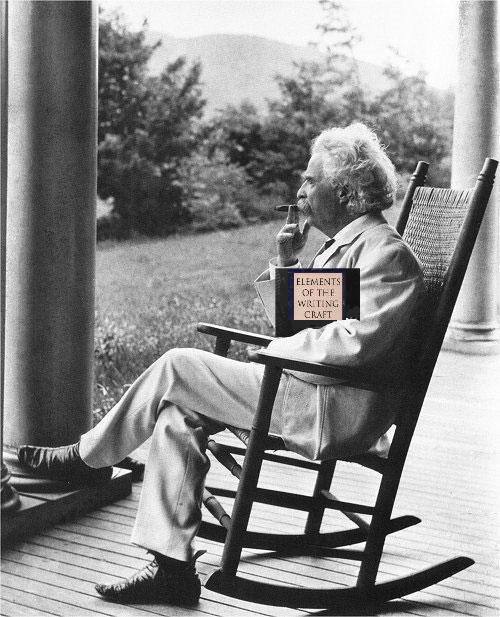
Mark Twain converts from pantser to plotter!

How come you never see plotters converting to pantsers?  Would this be an unnatural evolution?

I started out as a pantser, but did a lot more pre-plotting with novel #2 and even more with novel #3. I don't think I could go back to writing by the "seat of my pants." My life is so busy with other commitments that it's hard to justify the time to do first drafting without a plan, when I know it would result in restructuring and major re-writes.

Heads up: fantastic example from the Hunger Games coming up soon. Feel free to skip my musings on different plotting methods.

I'm still a panster, too. While I'm writing my first draft off my plot outline, suddenly a new idea will pop into my head, or my character will go off in an unexpected direction, and I go with it. That's pantsing.

But it's not a complete reversal from plotter to pantser, because before I go too far, I revisit my outline and work the new direction into the plot and my character sheets, readjusting to make sure everything still fits together.

With NaNoWriMo starting in less than a month, I'm spending October brainstorming and plotting to get ready for take off on November 1st.

Here's some pre-plotting methods I recommend:

First novel: after realizing that pantsing my novel resulted in glaring plot holes alongside way-too-complicated plot tangles, I chose the Marshall Plan for Novel Writing by Evan Marshall to outline my new, streamlined plot for a massive re-write.

Second novel, first draft: used the Marshall Plan with modifications from the Writer's Journey, by Christopher Vogler, which elaborates on the mythic structure of the hero's journey,  found behind most storytelling.

Third novel, first draft: used a combination of the two methods above, plus a beat sheet and other great tricks from Save the Cat, by Blake Synder.

So this year I am using all three methods above, plus another popular one: the Snowflake Method, developed by Randy Ingermanson at AdvancedFictionWriting.com.

These methods are actually pretty easy to combine because they are all based on the Three Act structure but each offers additional insights, tips and tricks.

I had to give the Snowflake Method a try because I recently read a tip from Randy Ingermanson's October newsletter that really impressed me.

You'd think folks would have run out of fodder from the Hunger Games by now - I've read soooooooooo mannnnnnnnnnnnny posts on writing technique with examples from this great book (and they've all taught great lessons). Here's yet another great lesson, thanks to Randy:

The Hunger Games is a deep and powerful story. The reason is very simple. Each of the two main characters has three values that are in conflict. Let's look at Katniss's central values:
* Nothing is more important than survival.
* Nothing is more important than my sister.
* Nothing is more important than avoiding love, because the more people you love, the more you have to lose
Each of these values is in conflict with the other two. Katniss decides early in the story that she values her sister more than her own survival. The ongoing conflict in the story comes as she feels a growing attraction to Peeta. Can she dare to return his love, when she knows with certainty that they can't both survive the arena?
Likewise, Peeta has three central values:
* Nothing is more important than survival
* Nothing is more important than protecting Katniss
*Nothing is more important than being true to who you are.
For Peeta, these values are in massive conflict.

I really believe Randy pinpointed the reason why the Hunger Games is such an emotionally gripping story. He goes into a lot more detail in his October newsletter. It's worth reading in full (actually, all of his monthly e-zines are worth reading).  But here's a great summary of it:

Look into your characters. Push them against the wall and make them fill in the sentence, "Nothing is more important than _________."
Take what they tell you and run with it. For the novelist, nothing is more important than values in conflict.
As I'm snowflaking-hero-journeying-beat-sheeting-Marshall-planning I'm also going to be brainstorming conflicting character values.

Story is characters in conflict, but powerful stories are also values in conflict.

BONUS: hey, just figured this one out my own! Identifying your character's values that are in conflict is a giant help with character development. 

Yeah, it takes me a while to see the obvious! (shaking head at myself)

Please share. Do you have a recent favorite movie or book where the main character has a conflict with values? (If you are especially brave, ask yourself this question about your own values, too. I have a HUGE conflict between two of my values. Maybe I'll share that some other time...)

Wednesday, September 28, 2011

Tidbits of teen (YA) culture

I love to read Young Adult (YA) which mean I also love to write it, though I feel so out of touch with today's teen culture (outside of the books I read!) that for my writing I stay away from contemporary YA, feeling a lot safer in historical and historical fantasy.

But my 16 year old stepdaughter decided to stay with us for the school year, so suddenly I've been getting a lot more contemporary teen culture than I ever bargained for! (Her friends are always coming over, not to mention all the stuff she shows me on Facebook and YouTube). So maybe I'll venture into contemporary YA for my next book, which is Science Fiction. SF doesn't have to futurisitc; you can have it in a contemporary setting, like I Am Number Four, by Pittacus Lore.

Here's some fun things from my stepdaughter that *might* show up in a possible contemporary YA story.

Newish teen vocabluary. I've noticed her saying "burn" a lot with a nice sarcastic flair. As in, "That girl is trying so hard to win her ex back. Burn!"

New superstitions. Whenever she drives through a yellow light, she smacks the sun visor. It's a good luck thing, she tells me. (let me state a caveat, by "new" I may be refering to "new to me.")

Wal-Mart Games. Okay, we live in a small town, and the only place open ALL NIGHT is Wal-Mart (though she does have an 11pm weekend curfew, ahem). Anyway, Walmart is popular hangout for teens - with the traditional cart-racing still high on the popularity list, but there's all sorts of other games, many to do with rearranging merchanise (oh dear). (just re-arranging. No stealing, she assures me).

Star tripping. (forget the cow tipping and the snipe hunts) (you can google it- fortunately, unlike some kinds of "tripping", this one's legal.

Arm workout. For a fashion-concious teenager, they get a great cardiovascular workout by flipping through clothes racks at lightning speed with one arm while quickly accumulating piles of clothes to try on in the other arm.

Teen formal wear. My daughter is going to the Homecoming Dance, so she and her friends pooled all their formal wear resources (owned and borrowed) and had a dress party for everyone to pick out their options. Startled by the current teen trends in formal dresses, I decided to look up a couple big stores online to see if these were, indeed, current fashion options.

Amazed by the - um - babydollish sort of trend of these clothes (and the tie dye/spilled paint effect!), I forwarded this picture to a friend my age to get her opinon.

I loved her response: "Oh my word.  Um… Speechless.  It looks like little girl dress up stuff minus the wings."

Just for fun, I had to post a picture of what my prom dress looked like (though mine was peach colored). Can you guess the decade?

Now, for the girl who wasn't so hung up on modesty, my decade also had teen formal dresses that looked like this:


It was so much fun looking up dresses online, I am half tempted to have a "Teen Prom Dresses over the Decades" blogfest!

So tell me your favorite teen tidbit, contemporary or otherwise.

And check out Sophia Richardson's 30 loglines in 30 days blogfest (I'm in!) (you don't have to post 30 loglines, it's not hard at all)

Wednesday, September 21, 2011

When infodump works

One of the first things you learn as a writer is what infodump is and why it's bad. Infodump is especially bad to have in your first chapter, along with too much of it's slightly more respected cousin, backstory. The advice you hear is to avoid infodump by weaving the background information in slowly and in small bits, or weave it in by showing, not telling.

I think I've noticed a trend toward spare writing, these days, too. If you can say what you need in a paragraph, great; if you can distill it down to a couple sentences, even better. Spare writing, well-done, is a marvel. Here's one of my favorite examples, from The Hunger Games:

When I wake up, the other side of the bed is cold. My fingers stretch out, seeking Prim’s warmth but finding only the rough canvas cover of the mattress. She must have had bad dreams and climbed in with our mother. Of course, she did. This is the day of the reaping.

On the other hand, right now I'm reading Spindle's End, by Robin McKinley.

Completely opposite of spare writing, but McKinley is still a best-selling author.

Here's the first paragraph:

The magic in that country was so thick and tenacious that it settled over the land like chalk-dust and over floors and shelves like slightly sticky plaster-dust. (Housecleaners in that country earned unusually good wages). If you lived in that country, you had to de-scale your kettle of its encrustation of magic at least once  week, because if you didn't, you might find yourself pouring hissing snakes or pond slime into your teapot instead of water. (It didn't have to be anything scary or unpleasant, like snakes or slime, especially in a cheerful household - magic tended to reflect the atmosphere of the place in which it found itself - but if you want a cup of tea, a cup of lavender-and-gold pansies or ivory thimbles is unsatisfactory. And while the pansies - put dry in a vase - would probably last a day, looking like ordinary pansies, before they went greyish-dun and collapsed into magic dust, something like an ivory thimble would begin to smudge and crumble as soon as you picked it up.)

This is arguably infodump. Not even backstory. Not even a single character's name, or any hint of a hook. And this is a loonnnnnggg first paragraph, with lots of showy parentheses and em-dashes. And the world-building goes on for pages, with the first character's name not even being mentioned until page 9 (and it's not even a primary character).

Yet, I LOVE it, and others do too. It's got a certain voice to it, definitely some charm, and an intriguing premise: a country so infested with magic that the resulting oddities can entertain you for pages (even without any characters, because the magic is itself a character).

Still, could something like this get published now? It was published in 2000, 11 years ago, with the author already having a very strong track-record.

Regardless, I'm happy to see a story breaking the rules all over the place and getting away with it. It's good writing. Here's an article that addresses why Spindle's End is good writing even though it breaks so many rules. (Another reason why it might be able to break so many rules is that it's a fairy-tale retelling. We already know the plot of Sleeping Beauty. The reason why we want to read it is to discover new details and twists).

Do you prefer spare writing, or wordy writing, or happy with either as long as it's good writing? 

Hey, for all you potential NaNoWriMo 2011 participants, or anyone else tossing around new ideas for their next novel, Sophia Richardson is considering doing a 30 loglines in 30 days blogfest during October, check it out for more details. You don't have to post 30 loglines - just a few - and just for fun (and to help us get our "idea muscle" in shape for November.)
Follow on Bloglovin
Follow on Bloglovin

Followers

My Blog List